
Buying Time
A Willerby Story

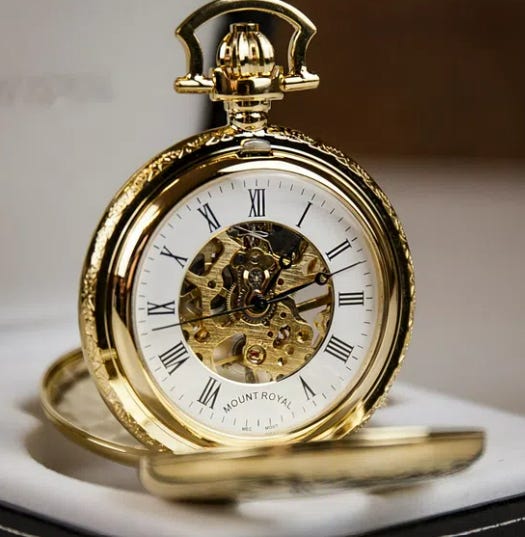
Lothar arrived in Willerby on a freezing morning in January in a taxi with a large oxblood leather travel wardrobe and a small titanium suitcase.
He had meticulous paperwork and impeccable references.
Although it was not yet on any of the websites, nobody objected to him renting the Sharp’s vacant Raven Cottage.
Tall, neat and thin, Lothar was never seen in anything but black three-piece suits, apart from Sundays when he wore brown corduroy and a floppy hat for a walk up and down the village.
His speech was entirely accentless and only his too perfect precision and the slightly archaic form of his sentences gave him away as being from overseas.
His work was watches and clocks.
They arrived with every post, sometimes in tracked packages, sometimes in plastic jiffy bags, sometimes in stiff card envelopes and sometimes in wooden crates as tall as he was.
He took them all in without fuss, worked at them in the dining room he made his workshop, and then, when they were ready, sent them back out again – all over the country, to Europe and to places further away.
“Everyone wants time,” he said to Josh who lived next door after he remarked on how good business seemed. “There’s always work for those who can provide it.”
Josh looked at him, squinting against the morning sun that made the man hard to see, as if the light was bending around his angular figure instead of illuminating it the way it was supposed to. “Do you sell clocks as well as fix them?”
Lothar gave a small, discreet shrug. “Yes,” he said, simply. “I do that too. Perhaps you would like to see some examples?”
Curious, Josh checked his watch, then sighed. “Maybe later today, after work? Will you be busy then?”
Lothar shrugged again. “I can make time,” he said. “Come whenever is convenient.”
…
Josh worked long hours and with two girls who had hobbies and social lives busier than his own, there was no opportunity until the next Saturday when Grace took them to gymnastics and then for a treat brunch in Beckworth.
Even then all the undone laundry and Friday night’s mess made him feel guilty sneaking out.
“I won’t be long,” he told himself as he knocked on Lothar’s door.
The house was kept very differently to his.
Used to toys, sports equipment and the perpetual cycle of clean-to-dirty, dirty-to-clean dishes and crockery, he found the neatness and order at first calming and then later unsettling.
It was – he supposed – easier for those with few possessions to keep tidy but even given that the sterility of Lothar’s home was remarkable.
The dining room Josh was ushered into was free of all personal effects. The walls were bare and there was no furniture apart from a long wooden table and chair and a floor-standing Anglepoise lamp.
“Very neat,” said Josh.
“My work requires it. I cannot be distracted, cannot make mistakes. Please come here and see what I am working on now. It will help you understand more easily.”
Lothar gestured him to the table where, in the pool of light cast by the lamp sat a disassembled old cuckoo clock, its gleaming gold wheels and gears arranged carefully around an intricately carved walnut casing.
“A very good piece,” he said, “but not cared for well by its last owner. The new owner understands and respects it. He wishes to do things better – a full strip down and rebuild. He hopes this will restore all its original functions. If you wish you may watch me work for a while.”
“I won’t distract you?”
Lothar shook his head as he sat down. “No,” he said, simply. “If you are quiet, you will not.”
Josh leaned in, fascinated. The delicate workings, each cog and spring, were beautiful and strange under Lothar’s long-fingered, pale and steady hands.
After some time, Lothar looked up, his expression so blank Josh wondered if he’d forgotten he was there at all.
“Would you like to see other examples?” He asked, simply. “Wait here and I will bring more.”
He brought in timepiece after timepiece; gilded carriage and mantel clocks.
Alarm clocks.
Wrist and pocket watches.
Pendulum clocks so large they had to be wheeled in.
All the gold and silver, the mother-of-pearl, the precious stones and the intricate carving and finishing soon overwhelmed Josh. The extravagance made him nauseous – a feeling like eating too many sweets and too much chocolate on an empty stomach.
“I have to go,” he said, suddenly, looking at his own watch, a basic black Casio. “I’ve been too long here already.”
Lothar put down the gunmetal half-hunter he was holding. “I see,” he said. “You’ve run out of time. But if you let me have your watch for just a moment, I can give you some back. An hour perhaps? On my account this first time. On the house, so to speak.”
Josh hesitated, unsure whether to laugh or protest. Then, shaking his head, he unfastened his F-91W and handed it over.
Lothar looked at it carefully for just a moment, pressed a sequence into the buttons on the watch’s side’s and then handed it back.
“There,” he said. “And call again if you’d like more. Any time.”
And then, without quite remembering leaving the cottage, Josh found himself in front of his own door.
He checked his watch, then the kitchen clock and then every other clock in the house.
They all said the same thing.
It was an hour earlier than it had been moments before.
…
The next Saturday, Josh went back to see Lothar.
“Hello, again,” he said, looking at Josh with unblinking eyes after ushering him into the dining room workshop. “You’ve come for more time.”
Josh thought about pretending for politeness’s sake he’d come to see Lothar work again but didn’t because he was sure the accentless man wouldn’t – maybe couldn’t – care.
“Perhaps just an hour again?”
Lothar nodded. “Of course. This can be very easily arranged. Sadly, this time I cannot give you the time for free. It would not keep balance.”
Josh had expected this and took out his wallet.
Lothar placed a light, delicate hand on his arm.
“No,” he said. “Time must be paid for with time. Second for second, minute for minute, hour for hour.”
Josh put his wallet away again. “How does that work?” He asked. “How do I pay?”
“Choose the time you choose to give. I do the rest. Perhaps later today in the evening? Or next year or perhaps the hour before your death, whenever that will be.”
Josh checked his watch and saw he had only a few minutes before Grace and the girls would be back, thought of how wonderfully cold and crisp the morning was and how quiet and peaceful the roads and lanes around Willerby would be to cycle through. He thought of the good a couple of hours on his bike would do him and how much better a father and husband he would be for the rest of the weekend.
He thought again.
“OK,” he said. “Seven till nine pm this evening.”
It was time well spent he thought later as he came back himself just as Grace flopped down next to him on the couch with a glass of wine.
“Something on your mind?” She said. “You were a million miles away through tea and bedtime.”
“I’m fine,” said Josh. “Do you want to put a film on?”
Grace shook her head and then flopped down against his shoulder. “I haven’t the energy for it. Maybe tomorrow if we can get the girls down a bit earlier.”
“Maybe,” said Josh, knowing they wouldn’t.
…
Josh became comfortable with then accustomed to and then addicted to buying and selling time.
At the start, finding time to sell was easy; the hour when everyone else was asleep before he left the house was the first of his regular slots; then the girl’s bath and bedtime – first once, then twice, then three times a week. Then gymnastics, swimming and dancing lessons.
Over the weeks and months and then for nearly two years, he took more and more shared time to pay for time to himself, spending his credits on long runs and bike rides, guitar practise, online German classes, special extra tasks at work and labour-intensive DIY and home improvement projects.
His friends and colleagues were impressed by his increased productivity.
At work his manager was so impressed he wrote “inspiringly efficient” on a letter recommending him for promotion and a pay rise.
Grace could not work out why she didn’t feel more pleased. She knew she should be. She worried she didn’t because she was envious, and the possibility of this made her feel petty and small.
“I don’t know how he does it all,” she said to Maya, her sister, on the phone while also stirring stew and mostly unsuccessfully trying to get one of the girls off their screens and onto homework. “By nine I’m a shell of myself but Josh always seems to have done as much as me and then something extra on top too. Last week he built sunken seating and a brick barbecue for the summer.”
“Men!” Said Maya. “They always have time for the glory jobs because they don’t even see the boring stuff that needs to be done just to keep the show on the road.”
“I know what you mean, but I don’t think it is quite that,” said Grace. “He’s always here doing.. stuff.”
Then she paused for a moment, realising she couldn’t remember him being around that much recently.
But he must be, she thought, because if he hadn’t been she’d have noticed.
She dismissed the odd thought and carried on.
“No,” she said. “He is always around even if he’s often, distant? Not all there? I dunno.”
Maya giggled.
“Grace,” she said. “Is he there when you really need him to be there, if you know what I mean?”
“Maya!” Grace said, blushing but laughing at the same time too. “Yes, he is, thank you very much.”
“Poor you,” said Megan. “Stuck with a man who’s a bit reserved but meets all your needs while he gets cool shit done. Sounds awful. How do you cope?”
Grace laughed at that and they went back to talking about other things.
After that she made a conscious effort to appreciate Josh and how his now seemingly boundless energy was enhancing their lives; she tried hard to think about the better holidays they’d have, how nice their garden parties in the summer would be and even tried to get herself interested in the sort of new car they could now afford.
But she always found it an effort and couldn’t shake a sense of emptiness.
She tried, a couple of times at least to talk to him about it but never felt heard. After each stilted, stunted conversation she couldn’t even remember what he’d said.
…
Alone.
Lonely.
The words for how she felt came to her as she sat on the toilet in the middle of the night while the rest of the world was asleep and silent.
…
On a cruel Sunday afternoon in late July, Jasper, their three-year-old black-and-white collie collapsed on the kitchen floor.
When he tried to get up his claws scrabbled on the lino as if his legs wouldn’t obey him.
Grace phoned the emergency vet while trying to calm the girls, who turned out to be right to be terrified; Jasper was dead by the time they got him there.
That night the girls slept in the same bed, Grace with them, until they’d cried themselves to sleep.
“Josh, where were you?” Grace hissed at him when she’d finally let them and a long time after that he came to bed.
He looked at her strangely, thinking hard about what to say.
“What do you mean?” He said, eventually, too steadily. “I was here.”
“I don’t remember you being here,” said Grace. “Even if you were, it was as if you weren’t. You might as well have not been. I felt like I was all on my own.”
She turned her back on him, sobbed for a while to herself and then went to sleep.
Josh lay awake for a long time and after that cut down his transactions with Lothar.
But it was hard and it didn’t last.
Increasing amounts of his life felt too tedious and irritating to bother being present for.
Picking up stray clothes and discarded make-up and jewellery.
Sorting the recycling.
Stacking, unstacking and stacking the dishwasher.
Listening to monologues he didn’t care about.
Knowing he didn’t have to be there for any of it made it worse.
Lothar’s house was so close.
A short walk, a brief passionless conversation and then hours – so many glorious hours – to himself to be spent exactly how he pleased.
It wasn’t even as if being there more brought him any closer to Grace. They never had time to talk properly and, both dispirited by the mundanity of everything, their exchanges were tense and snappy.
“You know where the gloves are.”
“Would it kill you to put the bins out when they’re full?”
“How about you reply to your own mum and dad about next Tuesday?”
“I’ve told you, just don’t listen.”
…
“I need you to pay better attention,” snapped Grace at Josh in the middle of an argument about pick ups from after school clubs.
“But why?” Josh said, unguarded in the moment. “Everything we ever talk about is so boring.”
“What’s boring?” Grace shouted back at him. “Our girls? Me? Our whole fucking lives?”
There wasn’t anything Josh could say that wouldn’t make things worse, so he said nothing, sullenly and silently wishing to be anywhere else.
And soon he was.
It was good – he thought – to be able to so easily escape and for more weeks and then more months they all went on just like that.
…
Barely acknowledged and uninterrogated guilt Josh felt made him promise himself he wouldn’t buy any time from Grace’s fortieth birthday weekend.
He prepared mentally for it with the same grim determination in denial alcoholics approach Dry January; a necessary unpleasantness that would allow him to plunge back into his habit guilt free once it was over.
They chose the cottage in Hathersage for their memories of trips to the Peaks with the university mountaineering club where they’d first met.
Josh realised it was a mistake before they’d even unpacked to have tried to turn back the clock.
The cottage was smaller, gloomier and dirtier than the booking.com photos.
The girls argued about the beds and then seemingly out of nowhere Grace shouted at Josh for forgetting the cafetiere. He shouted back which made Grace cry in anger and frustration.
He stormed out using the necessity of at least instant coffee as a pretext.
He found a shop quickly and then went to the pub next door for a sneaky pint, which turned into two and an hour on his phone.
When he got back Grace was asleep – or at least pretending to be – and the girls were in bed blankly scrolling their IPads.
He went back out again, drank more beer, and slept on the couch.
The next day was just as bad.
It began raining just as it got light at around eight and didn’t stop all day.
Unable to face the hills they trod the village’s sopping grey pavements in plastic anoraks, browsing overpriced art galleries and stuffy, overheated outdoor gear shops selling rucksacks and discounted tents.
They had an indifferent lunch in an indifferent café nobody wanted to eat in, and then argued about whose fault that was.
Grace went for a walk on her own, the girls went back to the cottage for more screen time in their room while Josh screencast a football game from his phone onto the modest flatscreen in the poky living room.
It was a boring match and his team lost 1 – 0.
Grace’s birthday dinner was marginally better because they’d booked a nice restaurant weeks before and the starched tablecloths and sotto-voiced waiters conditioned them to better behaviour, but as soon as it was over low-level misery descended on them all once more.
What a waste of time it all was, Josh thought, just before he fell asleep.
…
Grace was up before Josh, packing and they were on the road just after nine.
The rain had stopped but it was much colder and the sky was dark and heavy.
“Might snow,” said Grace, checking her e-mails.
“Surely not in April,” said Josh, drumming his fingers on the steering wheel.
“Would be just our luck if it did,” Grace said.
Half an hour after setting off snow did begin falling – at first light sleet and then, very quickly after that, thick, fat flakes that flowered on the windscreen before being swished away by the wipers.
The snow began settling on the road and Josh slowed the car as he hunched over the dashboard, peering intensely out at the storm through the arc swept clear by the blades.
“This isn’t safe,” said Grace. “We should pull over and check the forecast.”
Josh nodded.
“Yeah,” he said. “You’re right – was thinking the same thing. As soon as I see somewhere we can, I will.”
Grace twisted in her seat to look at the girls behind her.
“You’ve both got your belts on, haven’t you?” She asked.
They crawled along for another mile or so in a high gear and light on the breaks.
“I see something ahead,” said Grace, squinting. “I think it’s the sign for a pub. Pull in there?”
Josh saw it too, flicked on the indicator and brought them in a wide, steady arc.
With the wipers off, the windscreen went white immediately and in just a moment it was if the whole family were in an igloo.
“Are we stuck?” One of the girls asked, sounding more excited than scared.
“What does the forecast say?” Josh said.
“I can’t get on the internet,” Grace replied after a minute of stabbing at her phone. “There’s no signal.”
Nobody said anything.
Josh turned the car back on – for something to do rather than for any purpose – but the snow had grown so thick the wiper blades made an angry clicking sound but didn’t move.
“Right,” he said. “All out. We’ll go to the pub and ask.”
As they trudged through the blizzard the girls, already hand-in-hand, reached for Grace who reached for Josh.
The pub was open.
It was shabby but warm and clean, and while there was no signal there either and the WiFi was bad, the landlord had a computer with a wired connection and told them the Met Office was saying the snow would fall all day and wouldn’t melt until the next at the earliest.
“You won’t get out before tomorrow,” he said. “We’ve got a room though. Upstairs. It’s not that big but it’s got a double bed, a single and a futon I can pull out for you. I’ll give it to you 25% off. Call it an Act of God Discount.”
Josh sighed. “Work,” he said.
Grace put a hand on his arm. “Send them an email,” she said. “Then forget about it. There’s nothing you can do about it now. Let’s make the best of it. It might even be fun.”
They had huge brunches and then made a snowmen and snow angels in the pub garden until the cold drove them back to the fire blazing in the open hearth. They warmed up and went back out again just as it began to darken, marvelling together at the white flakes against the hills and dark skies.
They ate pie and mash. The girls drank hot chocolate and Josh and Grace drank pints. Exhausted by the day, the girls were asleep by nine.
Josh and Grace stayed in the bar, sitting next to each other facing the largest window, their knees and arms touching.
Grace said she was cold, although she wasn’t really, and Josh put his arm around her.
She snuggled in.
The temperature rose rapidly the next morning. By breakfast the fallen snow had gone grey and slushy and the road outside was almost clear.
“Do you want to take the stuff to the car or settle the bill?” Grace asked. “And the correct answer is ‘take stuff to the car.’”
“I absolutely want to take the stuff to the car then,” Josh said, kissing her on the cheek.
“Good,” she said.
“Comfortable enough night given the circumstances?” The landlord asked her as she settled up. “If it’s any consolation you were lucky. We’ve been cut off for much longer than a night before.”
“I wouldn’t have minded,” she said. “We’ve had a really nice time.”
“The room’s free all week if you want to stay longer.”
“That’d be lovely, but my husband has work,” said Grace.
“Shame,” said the landlord.
“Yeah, a shame,” Grace said. “Anyway, he’s been a while. I should go and check how he’s getting on.”
…
When Grace got to the car, following Josh’s footprints in what was left of the wet snow, he was bent over, the dashboard, his chest heaving.
“Josh? What’s wrong? Are you crying?”
As Josh turned to her she realised he was laughing so hard he couldn’t speak.
“The car won’t start,” he managed to get out eventually. “I left it on overnight and the battery’s flat.”
“You’re joking,” Grace said, beginning to laugh herself.
“Nope,” said Josh. “I’m a fucking idiot.”
“Yeah,” said Grace. “You always were.”
Then they were hugging and then they were wrestling, and then the girls who’d come to see where they’d gone were on top of them both and they were – all four of them – screaming in delight in a huddle on the wet ground.
…
“The thing I learned that weekend,” Josh told Grace years and years later when it finally felt safe to talk about worse times. “Was you have to be ready to be happy at any moment.”
…
They day after they eventually returned from the Peaks, Josh went to see Lothar one last time to put an end to it and make things right, but all the lights were off and when he knocked there was no answer.
Later that day, in the evening in the Green Man, Josh asked Mauve, who always seemed to know everything, what had happened.
“While you were away, they traced an infestation to that house,” she said, looking at him with her curious grey eyes. “The whole place was riddled with parasites. He’s gone. He aint coming back. Dirty one, he was. Good riddance.”
…
The End.