
Postcards
A Willerby Story

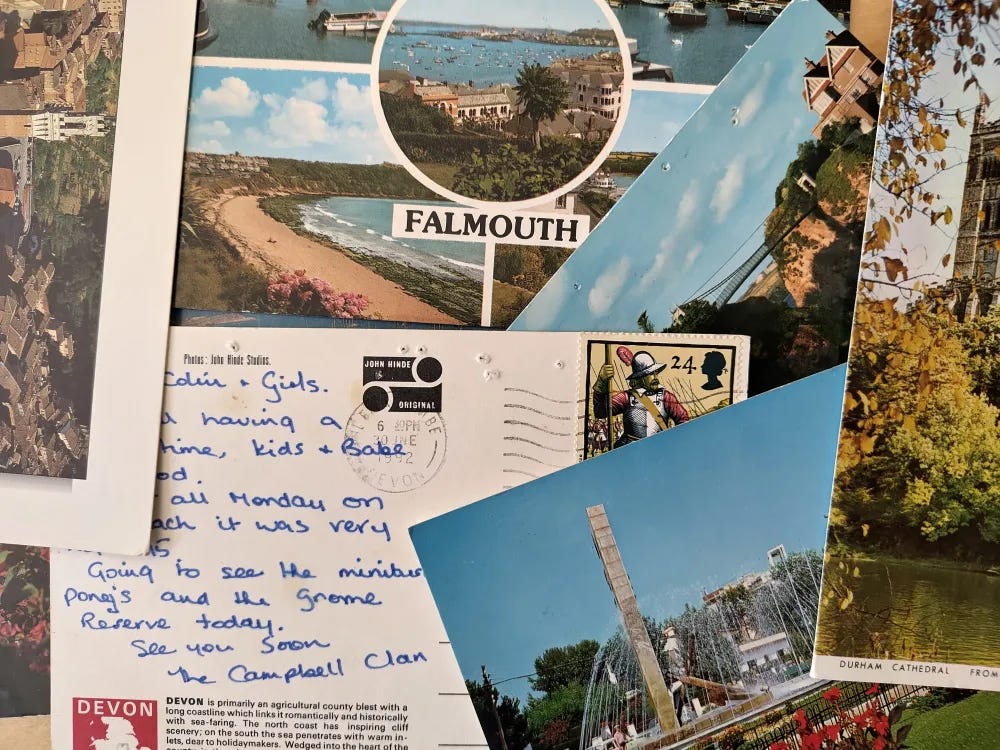
Tom had always loved the postcards his grandmother sent him from her holidays.
As each year went by and the world gradually gave up on mail for texts, then thumbs-up emojis and disappearing messages he missed them more than ever.
Every trip he took he bought lots, wrote fewer and never got round to posting any.
Over the years he accumulated dozens and dozens in a shoebox on a shelf in his study.
Blue seas and white cliffs, heather-topped mountains, mosques and minarets against red-gold sunsets, whales blowing steam into frigid air, places that forged memories, places he’d wanted to tell people about, but never had because things happened and then other things, and then the holiday was nearly over and how much did any of it really matter anyway?
Tom was 0.8 at work and on Wednesdays he did the school run.
After dropping off Martha and Mikey, if his chores weren’t too urgent, he liked to browse the Beckworth charity shops, a habit that exasperated Sarah, his wife.
“What are you going to do with another lamp?”, she’d say, hands on hips, somewhere between annoyance and amusement. “And before you say anything else it isn’t going in the bedroom.”
One hot July morning just before the school broke up and with holidays on his mind, Tom found a clutch of postcards in a basket in the Age Concern on the high street – mostly British coastal and countryside scenes, a few from further-flung destinations.
He turned over a postcard of a waterfall in a green wood.
Like the ones in his shoebox, it had never been stamped but unlike them was written and addressed. “Weather shit, food lovely,” it said in scratchy blue biro, “love you lots, see you soon. Bob.”
Tom turned over another, began to read and then he was lost in the forgotten inconsequentialities of other lives.
“You’d have loved the gardens we went to today.”
“Wish we could stay here forever but wish you were here with us too.”
“Went swimming yesterday, fancy meal this evening. Please remember to pay the milkman. Love Joyce. Wish you were here.”
“Wonder if they did,” Tom muttered to himself.
“Say something, mate?” asked a bored looking young woman from behind the till.
“Yeah,” Tom said, then tailed off. “It doesn’t matter. How much for these?”
The woman came out from behind the counter and looked over his shoulder.
“Not much use to anyone now,” she said. “Written already. If there’s a picture you like just take it and drop some change in the bucket.”
“I want them all,” Tom told her.
The young woman looked at him. “Why?” she asked.
“Dunno,” said Tom.
The woman looked as if she were about to say something, shrugged and changed her mind. “OK then – how many are there? Twenty or so? Say a fiver for the lot and you can have the basket too.”
…
Tom put the basket next to his shoebox where they sat quietly for a day or two.
Then in breaks between his Teams meetings, the cards began to talk to him.
“It’s even rainier than home”, whispered a woman with a scouse accent.
“Sea’s a lovely temperature,” whispered another in Brummie. “We’ve been swimming every day since we got here.”
“Ate a crab for the first time – not worth the fuss if you ask me.”
The postcards grew steadily more insistent until it was impossible to concentrate on anything else.
He moved them into the drawer of a roll-top desk in the lounge, but they raised their voices and put him off the TV.
“Maybe in the cabinet in the corridor outside Martha’s room? I could get some sort of thick box for them?” He half-heartedly suggested to Sarah.
She was having none of it.
“Oh no you don’t, Thomas,” she said. “You made this mess, so you clean it up. Martha’s only just begun sleeping through and I’m not risking that.”
..
An idea came to him in the middle of a humid, hot night as he was moving into the spare room where it was cooler.
Perhaps the postcards needed to be sent on.
He could do that.
…
Tom posted two of the cards the next day and that was that for them, but as if in protest at being left out the other cards raised their voices. The following morning, another Wednesday, he bought a book of stamps in a Beckworth newsagent and posted them all.
After that he did the charity shops and accepted, with a weary resignation, the appearance of another stack of written but unsent cards in Age Concern as an inevitability.
“Who brought these in?”, said the same woman. “I swear they weren’t here last night. It’s like they appeared out of thin air.”
Tom posted these, and those that came the following day and the cards that came the week after that too.
“This is getting silly,” Sarah told him, on the couch, her feet in Tom’s lap, as they stuck stamps to the latest batch of cards together. “You’ve done your good turn. Give it a rest or who knows where this will end?”
“Yeah, you’re right,” Tom said. “I’ll make this the last lot.”
“Good,” Sarah said. “And stay out of the charity shops for a while. Poking around in other people’s old things is how this stuff always gets you. Now rub my feet.”
…
Two days later, a box of unsent cards arrived at the house. They were so loud that Tom could hear them from the bedroom.
He checked his email and discovered—though he had no memory of it—that he had ordered them from eBay at midnight, the night after his conversation with Sarah.
He took a photo and sent her a WhatsApp.
“You aren’t going to be happy about this.”
…
He posted them.
By Friday another parcel arrived.
By Monday there were two.
…
“We’ve got to put a stop to this,” said Sarah in the kitchen a week later as they got breakfast ready for the kids. “I can’t hear myself think!”
“Maurice loves the beach,” said a card above the others.
“Would you believe restaurants don’t even open until nine here?”, asked another.
“Your dad tried sardines!!! Guess what??? He didn’t like them!!! But I said well-done anyway!!!”
“Tom!” Sarah shouted above them, her fingers in her ears. “Do something!”
“I know, I know,” said Tom, moving the latest cartons and boxes into the office and shutting the door. “I’ll get rid of these today.”
“I think when you do that you just encourage them though,” said Sarah, kissing him on the cheek as she left for the school run. “Post these on but have a proper think too. Enough is enough. We’re not spending the rest of our lives in a Roald Dahl story.”
After posting the cards in the Willerby post box by the pub, Tom took a walk around the village.
He couldn’t stop thinking about all the undelivered messages in the world, at the bottom of bags, folded into books and magazines and in shoeboxes, all the many things everyone means to say and then forgets about.
As sad as this was, it was impossible to pass them all on.
They must know that, he thought.
What then, could they want?
But nothing came to him and then it was time for work again.
He tucked his shirt into his tracksuit bottoms and logged out of the uncanny and onto spreadsheets, reports and online meetings that were somehow both important and completely unimportant at the same time.
Every meeting about budgets and feedback loops would be archived forever, he thought, while the things people most wanted to say disappeared into drawers and shoeboxes.
At ten-thirty he took a break and, as he sipped his coffee the silence of his own cards on the shelf above his computer struck him as suddenly awful – at least the cards from the charity shops and the internet had voices.
He hadn’t given any of his even that.
He took them down and picked one out at random – a photo of the square of a walled Rioja town from a road trip through northern Spain he’d taken with Sarah only a year or so after they’d got married. The place came back to him – cobblestones so clean and white it was as if they’d been polished, flamenco buskers under the stars, the golden cat they found sleeping on the bed of their apartment when they came back from eating pinchos for dinner.
He tried to remember where exactly he’d bought the card from but couldn’t.
It didn’t matter.
Those days and nights had been among the best of his life.
Had he known then? Had he told anyone? Had he even told Sarah how happy he’d been?
He wished he’d sent a card to someone, anyone, even if all it’d said was he was having a lovely time.
Tom’s coffee grew cold as he sat with the memories until another meeting came and went without him, and then one after that too.
He rifled through his box until he found the card he was looking for. Then he took a pen from the Cool Daddy mug the children had bought him for a Father’s Day present.
“Dear Grandma,” he wrote. “Sorry, this took so long but better late than never, eh? Just wanted to say we’re having the time of our life. I’m so in love with Sarah I don’t know what to do with myself sometimes. Sorry you couldn’t make our wedding. Love Tom.”
He addressed it to the bungalow she’d lived in last. She wasn’t there now, but he didn’t think that would matter.
And he sent more and before long he was writing cards all the time.
He sent them to his brother and sister, to university friends, to his godchildren and most often to Sarah. The first he wrote her was about Rioja too.
“Sarah – I love you more than I did then,” it said.
Two days later he found her reading it at the kitchen table crying into her morning coffee.
“Thank you,” she said.
Two days later he got a card she’d written him.
Before long he ran out of unsent cards, but that was fine.
There were always more to buy because there was always more to say.