
Road Songs
A Willerby Story

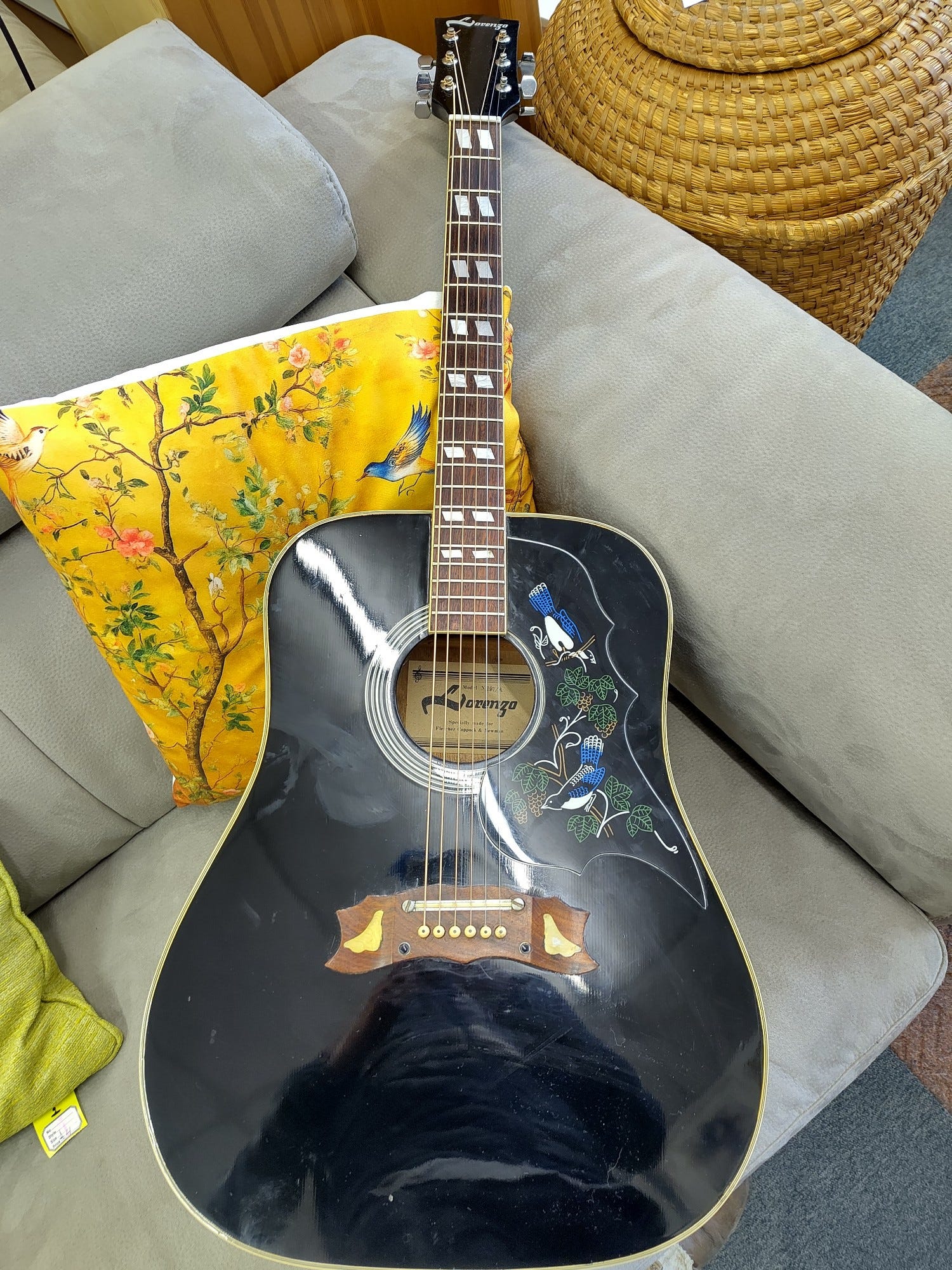
After finally getting rid of a Yamaha he’d never much liked, finding a 70s Lorenzo for sale in the Beckworth Bloodwise felt serendipitous.
£220 – was higher than Dan expected for a charity shop guitar but a few moments googling brought him quickly up to speed as to why.
The guitar – a shining jet back with bright blue-and-white birds perched in more muted green foliage on the scratch plate – was a minor vintage classic.
Nothing to get too excited about but interesting – a good quality rip-off of a Gibson that had a small and unfussy cult following online.
“Working man’s Hummingbird.”
“Brighter, with better bass than it has a right to have given the price.”
“Old guitars have souls and even knock-offs back then were better quality than most modern crap.”
“Worth fixing up, if you find one that needs some love.”
Dan put his phone away and looked at the guitar closely.
It had a few tiny scratches and nicks but was - polished to a high shine and newly strung - in a beautiful condition for an instrument at least fifty years old.
“Mind if I try this out?” Dan asked a bored-looking young woman with tattoos and piercings.
“Go ahead,” she said, then went back to scrolling.
Dan carefully lifted the guitar from its stand, settled himself into the leather chesterfield opposite and strummed a G chord, then a D, then a C.
“Wow,” he said to himself.
“Sounds good,” said the tattooed young woman.
Dan muted the strings and looked up at her. “It really does,” he said. “She sings, doesn’t she?”
He strummed out another pattern, picked out an arpeggio and then let himself drift away to the music.
The woman came out from behind the till and settled herself into a green velvet chaise long to listen
“You’re really good,” she said, when he stopped. “How long have you been playing?”
“Most of my life but really I’m no better than competent,” said Dan. “A few chords, a bit of basic soloing until I run out of ideas – but this guitar is making me sound much better than I really am.”
“You should buy it.”
Dan thought for a moment.
“It’s not super cheap,” he said. “You’ve done a good job pricing it.”
The woman shrugged.
“AI does it all now,” she says. “Harvey – he was working when it was donated, just left outside the shop actually, just took a picture of it and Chat GPT or something like it did all the rest.”
“Would you take an offer?”
The woman bit her lip and tilted her head to one side.
“I dunno,” she said. “I should check, but on the other hand fuck it. This is my last shift so why not? Make one, just don’t take the piss - it’s for people with cancer.”
“£150?”
“£180 and you get the other stuff that came with it too.”
Dan thought for a moment, then thrust out his hand. “Yeah,” he said. “That’ll do.”
After he’d paid and the guitar was safely stowed away in its hardback case, the young woman followed him to the door to see him off.
“Thank you, and good luck with your new job,” said Dan.
The woman grinned at him. “I haven’t got one – I’m at college. Got done one too many times for shoplifting from Boots and I’ve just finished my community service.”
Dan laughed. “Learned your lesson?”
“Probably not,” she said, and laughed back. “I don’t even need the stuff. Life’s boring, you know, and you have to find ways to put at lesat something exciting into it or you’d go mad.”
…
“It’s pretty!” Sally said when he showed it to her back in Willerby. “What a lovely find.”
“It sounds great too,” Dan said, lifting it out.
“What’s all that stuff in the case?” Sally said, peering in.
“Some photos, some paper. I haven’t had a chance to look properly yet though.
Sally reached in and lifted out a handful of faded Polaroids, fanned them out over the kitchen table.
One photo showed four young men in denim with long hair and moustaches, their arms around each other in front of a splitscreen VW Camper, another was two of the men with two blonde women; three of them standing within a ring of standing stones, then all four again on a small stage in front of a closely packed audience of men and women in flowing flowery shirts and bellbottom jeans.
“Ah, look,” said Sally, pointing at the final photo, which showed one of the men – the one with the longest and bushiest hair – sitting on a stool in a greasy-spoon café with Dan’s guitar cradled on his lap, grinning, forever frozen in a drag from a cigarette.
“Imagine looking as cool as that,” said Dan.
Sally smiled at him. “You did. We all do. But none of us know it at the time.”
Dan looked at the photos again, arranged them into a neat pile and pulled out a stack of paper from inside the case.
“Sheet music, mostly tab,” he said. “Flying Burrito Brothers, Byrds, Crosby, Stills & Nash, some early Dylan. Country-rock stuff. Makes sense. Goes with their look.”
“I wonder who they were,” said Sally. “They look like they’re having a great time.”
Dan spread the photos out again. “Yeah,” he said. “I’m going to guess Americans on tour here? The internet says the guitar was an import from Japan to the US so it wouldn’t have got here without someone bringing it. Probably our guy here.”
“And he left it behind,” said Sally, thoughtfully. “But we don’t know why.”
Dan nodded as he looked back in the case. “One last thing in here – looks like a child’s school exercise book.”
He put it down on the table, yellow cover facing up.
“Road Songs,” Sally read aloud, and opened it to reveal the handwritten lyrics of a song, the chords above the words picked out carefully in red. “Could you play them?”
Dan half-shrugged. “I could have a go,” he said. “But it’d only be an approximation. Without hearing it sung the chords won’t give me the melody.”
“You should,” said Sally, turning away and back to the washing up. “I think you’re being asked to.”
“Is that wise in Willerby?”
It was Sally’s turn to shrug.
“I think we’re beyond that. For better or worse, whatever’s going to happen is going to happen now.”
…
Dan waited until Saturday afternoon when he had the house to himself to have a go at the Road Songs.
He brewed a coffee, took the Bluebird to the swivel chair under a warm spot under the big window, opened the yellow book and began, slowly and tentatively at first, to strum through the songs inside it.
The chord progressions were nothing fancy – Gs, Ds, Cs, with some A and E minors thrown in to keep things interesting.
Once he had established a plausible pattern, he began trying out the lyrics of the first song – simple, clean and satisfying lines on travel – wheels on winding lanes, spring rain on windows, the whisper of wind in trees, poetry that went close to but stayed just on the right side of cliché.
For a while he couldn’t make them scan but then – just as he had suspected might happen – something clicked and suddenly he was high and low in all the right places and the song was there.
A few moments later he noticed – again with no surprise – that his voice was changing, now deeper with a gravelly catch in it, long southern vowels accenting the words, making them yearn, lonely and homesick for dust and heavy heat, depth to beauty that was already there.
Lonesome, not lonely, he realised just as he came to an end.
The sky had clouded over while he’d been playing, and rain pattered against the window.
His coffee had gone cold, but he’d forgotten about it anyway.
For a long time, he stared out the clouds.
And then he turned the page of the yellow book of Road Songs, picked up the guitar and began on the next song.
…
“He doesn’t sound like daddy when he sings,” said Sammy to Sally after coming down from upstairs the next week. “He sounds happy and sad at the same time.”
“Yeah, love,” said Sally. “Music can do that. How does it make you feel?”
“Happy and sad,” Sammy said. “I like it.”
…
Dan carried on practising. It was no effort.
He found it harder to stop than to start.
The songs – The Road Songs – were not particularly innovative or clever but they were compelling.
“They sound as if you should have heard them before,” said Sally to Dan one evening after Sammy had gone to bed. The sort of songs you’re obsessed with for a while but then you forget about. And then one of them comes on the radio years later and throws you back in time to how you were then – all the people, the places you went to, everything.”
Dan looked down at the faded photo of the smoking young man in the café he now kept in the folds of the yellow book.
“I wonder what happened to him and his band,” he said. “They were good. I can feel it. They should have got somewhere. More people should know these songs.”
“Maybe there’s a way more people can,” said Sally. “You should play them through with the Wrecks.”
“Yeah, I was thinking about that too,” Dan said. “They do need a bit more. A bass. Another guitar. Drums. Other stuff.”
…
The Tumulus Wrecks were the Trigger’s broom village band - Trigger’s broom because the Wrecks were whoever happened to be playing with them at any time and nobody knew who the first members had been.
Whoever had the time met upstairs in the Green Man every Wednesday evening. Dan had played with them regularly when he’d been less busy but had dropped out of the habit and got an ironic round of applause when he appeared with the black bluebird guitar in its case and the yellow book of songs.
“There’s nothing new in any of them is there?” Asked Paul, rhetorically, sipping at a bitter in the bar downstairs at the end of the session. “But there doesn’t need to be. They’re neat and tight and they make you feel stuff. They’re good. The sorts of songs people bond over when they find out someone else loves them too.”
“Cult classics not best sellers,” said Ed the fiddle player.
“I’d like to keep on with these for a while,” said Paul. “This all feels like it’s headed somewhere. Dan, can you spare the time for a few weeks?”
“Yeah,” said Dan. “I think it’s something I’m meant to do.”
…
Over WhatsApp, Facebook and Instagram to Willerby, Beckworth and beyond with the help of friends and family, The Wrecks promoted the Road Songs gig for weeks, and the Green Man was elbowroom only by the time they took the stage.
The show began at nine with the crowd just at the right point of tipsy – happy to be there, all ready on the band’s side, willing to do the work to make it perfect.
The magic began with the first chords of the first song strummed by Dan on the black bluebird, then filled in and out by Paul’s mandolin.
First it silenced the audience and then once they got the hang of the chorus had everyone singing along.
Later, Dan tried to explain the experience to Sally, but while he got close, he didn’t have the words to get all the way there.
“That sound at the beginning of a really big concert everyone there’s really excited about, when the band first walk on and the drummer thumps the bass drum – that cheer – that roar – if was like that the whole time.”
The set swept in another world and the room changed – hotter, steamier and good-sweat closer than the late winter dank February outside.
Songs of slow rivers, bayou and swamp, of neon motels and straight desert roads, songs of fried roadside food, cold beer and crickets in the heavy dark, songs of love and lust, songs of a home far away.
Wild applause, hoots and hollers at the end of each – stamping feet, clapping hands from all the seen and unseen people.
And then when it should all have been over, when there were no more songs to play, an encore of a song that hadn’t been in the book but was somehow just as familiar as those that had been.
Dan wasn’t at all surprised to see, as the very last chord died away, a young man in denim with long hair and a moustache standing right at the back, applauding with everyone else.
He was in the bar too, sitting at a corner table on his own under a window, drinking lager, ignored by everyone.
Dan took his pint over and joined him.
“Feel like I know those songs you played,” the moustached young man said. “Feel like I know them very well.”
“I think I found your book,” Dan said. “With your guitar.”
“An’ I’m glad you did,” the man said. “Was real good to hear them again.”
“It should you be playing them,” said Dan.
“You’re welcome to have ‘em. I can’t reach ‘em now. Been gone too long, too far away. I can’t for the life of me remember what, but somethin’ must’ve happened to us – me at least, I can’t speak for these boys, they aint here.”
“I think you deserved more,” said Dan. “I think your music deserved more.”
“I dunno, man. Last thing I remember we were having such a blast in your little ‘ol England. Playing the pubs like this one – little halls, all the boys and the girls comin’ to see us. Writing the new album in that little book. It was good times.”
The man raised his hand and titled it from side to side.
“So, on the balance, I’m alright with it. Back in the US of A, we opened for a few of the really big guys, and they seemed no happier than we were. What we had was special – we were in our second beer buzz, you know? That feelin’ when you’re jus’ liftin’ off and the anticipation of all the fun you’re about to have is so high that you know even then nothing’ll ever be able to live up to it. I don’t think it can get better that that. Seems to me I might just have checked out at the top.”
“Hey,” said a voice from behind them.
Dan turned and saw the tattooed young woman from the charity shop standing behind them.
“You aren’t just competent,” she said. “That was fucking brilliant.”
Dan smiled up at her.
“This is the guy who wrote the songs.”
The woman’s eyes widened.
“Really? Why don’t you play them yourself?”
“I need my band for that, and they aint here.”
“What’s your band called?”
The man grinned. “The Tumbleweeds” he said, sweeping his arms out and dropping into a theaterical bow, “An’, darlin’, believe me when I tell you we could really rock a joint. Best night of your life. Come sit down and have a drink with me. I’ll tell you all about it.”
Dan stayed until it became clear both would be grateful if he were gone.
Happy as he could be, he left them to it and went back to drink with the Sally and the Wrecks.