
The Swing
A Willerby Story

To get to the Willerby playground, take the turn from the Beckworth road onto main street.
Go past the railway cottages and the two outlying farms, past the pond and past the church, past the tumuli swarming around it.
Ignore the signposted path going up the hill to the old Roman fort and go straight on instead.
There it is, behind a white fence on the village green, across the road from the Green Man pub.
The equipment is old, but it’s neat and well maintained by the parish council - a climbing frame and slide, a seesaw, a roundabout and a modest menagerie of spring mounted rocking animals.
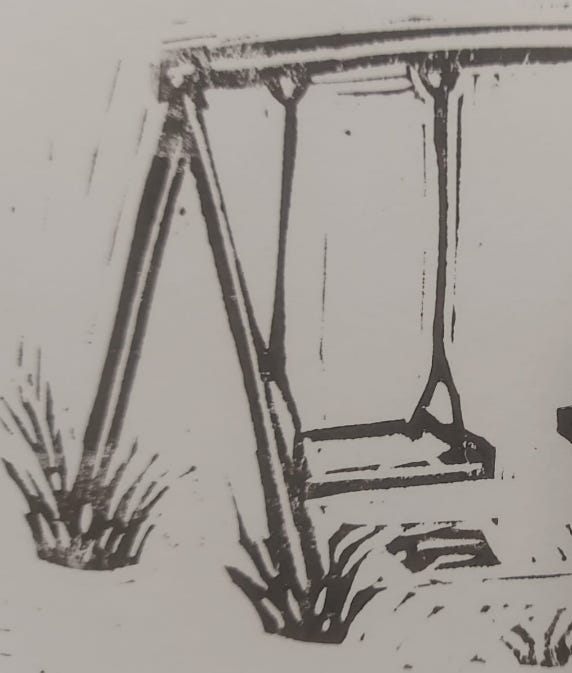
And – behind its own fence, in the corner by benches for the tired and bored adults - a wooden swing on iron chains.
There is just one, and so there is always a queue – usually managed by the children themselves with grace and good humour. Such arguments that do arise are mostly sorted out by the bigger kids with rarely a need to involve tiresome adults who never really understand the intricacies of the arrangements and are too impatient to learn.
When a child gets their turn, the child who’s next pushes them higher and higher, until they are flying, their stomachs lurching delightfully as the earth’s invisible fingers push and pull their small bodies through the layers of time and space.
When they reach the very top of the arc – when it’s not possible to go higher without looping back on themselves – the children call out what they see in high and excited voices.
Some are to be expected:
“The church!”
“The top of the pub!”
“The top of your house!”
Others more fanciful:
“My school!”
“The railway track!”
“The sea!”
“Mountains!”
And some that could only be dreamed by a child:
“Camels in a desert!”
“Sailing ships on a green rolling ocean!”
“A herd of dinosaur things!”
“Two yellow suns, next to two blue planets!”
Then, after a minute or so of the highest swings, the swinger slows, stops and then either runs round to join the line or away to another piece of equipment.
When she noticed, and then started paying attention to it, Sabine found it curious the children always played this game on the swing and never anything else.
Once, taking a shortcut over the green on the way to the pub, she asked Tim, her next-door-neighbour seven-year-old.
He just shrugged and said, “because that’s the game you play on the swing,” as if it were a stupid question.
The things children said they could see at the top of the swing were remarkably beautiful – often even poetic. Sabine found herself often sitting on the bench opposite the swing just to listen to them.
“Ice as far as I can see!”
“A beach of pink sand, like icing on a cake!”
“A city at night full of flying cars!”
Sabine – who was homesick and having a tough time at work - envied them their ability to go so high, to travel so far, to find escape, to transcend, but was not so envious she could not vicariously enjoy their journeys.
She found herself on the bench watching them more and more.
One late summer evening, as the crimson pink of the sunset gave way to a clear night, she stayed until there were only a handful left, then two, then just Tim, swinging on his own, calling out what he saw.
Then he too hopped off the swing.
“See you later, Sabine”, he called over his shoulder.
“Bye, Tim,” she called back, watching the swing, black in the dusk half-light.
He stopped and turned round.
“You might be able to do it too, you know,” he said, “but if you do you have to hold on tight. You mustn’t let go. If you fall off, you can’t get back.”
And then, before there was time to say anything else he was gone, running back home for a supper he was already late for.
Sabine looked again at the now motionless wooden seat, a black shadow in the darkening evening.
She looked round and saw she was alone.
What harm could it do?
She was pleased to find the knack came back to her straight away.
The first push, legs out on the upswing and tucked under as she swung back into the quickly growing curve, higher each time until as she reached the top, she could feel gravity losing its grip.
The world around her loosened and blurred, the evening colours bleeding into a watercolour wash, the whoosh of air raising goosebumps on her skin, the sound of the drinkers in the Green Man opposite becoming first indistinct and then fading away altogether.
And then – as she reached the very top – a window in the world opened before her and she caught a brief but distinct vision of verdant green rainforest below her feet, could hear the calls of bird and the howl of animals she was far too high to see.
“Forest!”
She swung back and it was gone.
Sabine had no time at all to consider what she’d seen because now she was coming up again, this time to a vast agricultural patchwork of green and brown and the deep, earthy-brown smell of soil and manure.
“Farms!”
She swung and swung, gasping at the visions of strange lands that opened below her.
Orchards and vineyards; seascapes; beaches and shoreline; coral reefs; tundra; a great wall threaded over mountains and valleys.
Sabine was so transfixed she moved her legs automatically, unaware of how high she was, unaware she was losing contact with the swing at the top of her arc, secured only by her hands on the chains, until she was above a volcanic lake, spitting lava, seething red, orange and white.
The intensity of the heat caused her to start, afraid of being hit by one of the bright streaks of molten rock dancing below her.
In her flinch she let go of the chains and for an instant was free in space and time, pitching forward and away from her own world towards this unknown one.
Then – instinctively – her fingers closed on the chain, gripping so tightly it hurt as it dug into her palms as she swung back.
The pain tethered her to reality, anchoring Sabine in the moment even as the worlds spun wildly around her.
Sabine kept her eyes closed as she slowed, terrified by the thought of what would have happened had she not regained herself, trying to comfort herself with the thought her instincts were good and there was no real chance she’d have ever really let go.
Her breath came in short, awed bursts.
She could still hear echoes—the distant thunder of waves crashing onto distant shores, the whisper of wind over arctic tundra and the dreadful rumble of the lava lake that hummed in dreams that haunted her for the rest of her life.
Her feet brushed the ground as the swing slowed.
Then it was over, and she was in the playground alone in the dark.
She sat there for a long time, steadying herself, allowing the sound of the pub and the ordinary breeze in the ordinary trees to bring her back to where she belonged.
Then, staggering, feeling a little drunk herself, she too went home.
…
Sabine never rode the swing again but still liked to watch the children.
“Did you ride it?” Timmy asked her a few months later, his feet crunching in brown autumn confetti, his breath steaming above his green and gold scarf.
“Yes,” she said, nodding, “I did. But I won’t again. I’ll leave it to you and your friends.”
Timmy thought for a moment. Grinned, as if relieved.
“Good,” he said. “That’s best.”
Always exciting to read a new Willerby story. This one reminds me of hours spent on the swing, until I felt transported to a different place, more than half a century ago.
Gorgeous!