
Urban Explorers
A Willerby Story

In a comfortable Cotswolds town, Marla, Connor, Gemma, Stuart were having a dinner party.
It was Saturday and they were all comfortable, healthy, and their children were old and sensible enough to look after themselves, so why not?
Near the end, after the tapas, wine and good bread, Marla cleared away the ice cream bowls and put out the cheeseboard.
Gemma held up her phone to take a photo.
“Gem!” Her husband Stuart protested. “Put that away. You’re getting as bad as the kids.”
“Ours take so many but they hardly look at any of them afterwards,” said Marla, arranging grapes between the edam and melted camembert. “They’re so busy recording everything they’re missing the best parts of their lives – I worry one day they’ll get around to scrolling back through it all and find they don’t have any proper memories.”
“I can’t remember any of my best memories!” Stuart said. “Put that thing away, Gemma!”
“Oh, stop fussing!” Gemma said, good-tipsy laughing, as she moved around to get better lighting and angles. “It’s just a bit of fun. And it can be really creative too. Tim’s got all these followers on Instagram from taking cool creepy pictures of abandoned factories and stuff. It’s called ‘urban exploration.’ It’s a whole thing. He says he even makes money from it somehow.”
“Urban exploring?” Marla put her hand on her husband’s arm. “Connor, isn’t that what you do with your Grimford friend on your weird weekends?”
Connor dipped the end of a baguette into the camembert. “It’s not the same.”
“It sounds the same. Breaking into old places, hanging out in them? That’s what you do.”
She turned to the rest of the table.
“He’s been doing it ever since I’ve known him. He got arrested for it while we were at university.”
“You got arrested? Stuart said. “Cautious Connor got arrested?”
“He did,” Marla said, then kissed Connor on the cheek. “It’s why I married him. I was a posh girl from Surrey, and he was this up-and-coming rebel writer from the north. And not long after we met, he was caught by the police in an old pub. He spent a night in the cells. I had to come and get him the next day. It was all very exciting and so of course I fell in love.”
“Never!” Gemma said, more impressed than shocked.
“I wasn’t properly arrested.” Connor said. They saw my torch and thought I was a burglar, but there wasn’t anything worth anything there worth taking. They took me to the station, but I wasn’t there for a whole night. They let me go after a couple of hours.”
“Do you still do it?” Gemma asked.
Connor shrugged. “When I get the chance.”
“Do you have photos and videos too?”
“I always ask him to, but he never takes any,” said Marla.
“Why do you do it then?” Stuart asked. “This urban exploring?”
“I always have. That’s all,” said Connor.
There was much more to it than that, of course, but Connor didn’t know how to explain.
…
Connor knew all about “urban exploration.”
He found the term forced and affected, a new label for something he’d been doing for almost as long as he could remember.
It began at the grammar school, where he hadn’t fitted in.
But he hadn’t fit in anywhere then.
Didn’t fit in the foster homes he bounced between, didn’t fit in the dirty, rainy streets of the decaying city he was born to, didn’t fit with his unstable, drink soaked and drug addled fragmented family, didn’t fit in with the cruel, clever children who nicknamed him, together with another boy, Hassan, The Two Stinkers.
Connor Morton.
Hassan Mohammed.
Next to each other on every register, next to each other in every classroom, Connor smelling of stale smoke, black mould and sweat, Hassan of his father’s takeaway.
…
Connor was quiet.
He knew it was best not to make a fuss.
But all children have breaking points.
At the beginning of his second year at the grammar, after a whole summer with an old couple who had been kinder than most, Connor ran after he was told his mother had decided she wanted him again and he had to go back to her and her new boyfriend at the end of the day.
When they told him, something snapped and he burst out of the small room, ran outside to the jeers and catcalls of the other boys, ran faster than the adults could run, ran for nowhere till his lungs burned and a stitch forced him to a juddering stop on a bench by a bus stop.
There he watched the pigeons, not knowing what to do next, trying not to think, until a few minutes later, Hassan found him.
“I ran as well,” he said. “I hate it there too.”
Connor looked at his old, dirty shoes.
“I won’t go back.”
“Hassan shrugged.
“I know a place we can go.”
…
They went to a wasteland.
They squeezed easily through a gap in a fence and pushed through thigh-high rough grass, moving carefully to avoid hidden broken bricks and twists of rusted iron.
The ground floor doors and windows of the old mill were barred, but most had been either weathered or wrenched away from the smog blackened stone.
Inside, they explored for a while and then sat together on a bench by a giant wooden table once used to cut fabric, making up insults and names for children and teachers they’d never dare use.
When it began to get dark, they went to Hassan’s terraced house where his father gave them both a bowl of deep, red savoury meat curry with chapati and a yoghurt drink.
The spices were strange, but the food was good and Connor was so hungry he ate two more helpings.
Hassan and his parents went upstairs to talk while he finished, and Connor waited quietly for them at their Formica table.
“Dad says you can always eat here or at the shop,” Hassan said when they came down. “But he says we can never leave school again and he says he has to call them now.”
When the Social arrived to take him away, Hassan’s mother took him into an unexpected embrace and kissed him on the cheek. She gave him samosas, wrapped carefully in white paper inside a brown paper bag.
He could not work out why she was crying as she waved goodbye to him from the street.
After he had his own children the memory of that day came back to Connor, and he found himself struggling for breath in his car as he watched them play in a park, because then he understood why Hassan’s mother had wept.
…
Connor could only bear school because of Hassan, and Hassan could only bear school because of Connor.
The Stinkers haunted the margins of the dark Victorian building hiding from the chants and taunts.
“Stinkers, stinkers, where are you? We know you’re near we smell poo,
Stinker, stinker, where is it? You can’t hide, you smell of shit.”
But the boys were wrong, because The Stinkers were very good at hiding.
The bushes around the field; the art resource room upstairs that was never locked; the boiler room of the disused swimming pool; the almost but not completely walled off auditorium; the snicket between the theatre and a fence with bars wide enough for the two Stinkers to slip thorough at the end of the day.
In the evenings, at the weekends and in the holidays when neither ever went anywhere, except the summer when Hassan went to Pakistan and Connor was every minute sick with fear he would not return, the two boys explored all the lost, abandoned places they could find.
Mills, factories, workshops, cellars, churches and pubs.
They became skilled at breaking and entering undetected, learning to love the places only they knew about.
Much later, long after he left, Connor heard another writer also from Grimford say she had grown up in the ruins of a fallen civilization and felt his soul rise in recognition.
It was exactly that.
Vast echoing factory floors whirring with the wings of startled starlings rising into strange helix murmuration and then away into the sky through the shattered windows.
Cavernous churches with rising, twisting dust clouds hazing green and blue in the light of high, splintered stained glass.
Aisles of cobwebbed black machinery throwing cogs and gears on sawdust rough wooden floors as it rusted away.
Small offices with page-three-calendars, blackboards and posters displaying shift start and finish times and the penalties for arriving late or slacking off.
Once, best of all, in a hanger-sized corrugated iron shed in a green jungled copse, a red and gold electric tram with the uniform cap of its last driver hanging from its massive brake handle.
Connor and Hassan spent almost all a hot summer there, playing, fantasising better lives, collecting the old coins, ticket stubs and cinema tickets they found between its seats.
They looked, but the year after they couldn’t find it.
Either someone had removed the tram and dismantled the shed or they’d both forgotten where it had been.
Or something else.
Because Connor’s memories of those hot months, riding the tram through busy streets, waving at cheerful men in bowler hats and women in colourful dresses, couldn’t have been real - must have been the shared invention of two lonely boys using their imaginations together to escape.
When Connor thought of them, other memories that could not be real memories came to him too, layers of old worlds that were not his, images of people and places that slid away when he tried to focus on them, leaving bittersweet nostalgia and loss – a sense of having been in places that were like dry riverbeds running suddenly with floodwater, gone as fast as it appeared.
Whatever it had been, whatever Hassan and he had done, was worlds away from Tim’s Instagram “derelique chic” photos Gemma sent to him the day after the dinner party.
They were staged.
The circle of velvet-upholstered chairs in the centre of the ballroom was too perfect, the crimson voodoo graffiti on the tattered wallpaper, lit by a professional off-shot lighting rig was too American and too fresh-sharp to be genuine.
This sort of stylisation, Connor and Hassan found, was happening more as the internet and social media drove new breeds of influencer to places that had become a tourist trail.
They’d become used to finding places that should have been theirs ruined by previous visitors.
Connor hated it, hated the realisation a place he had been spoiled, feeling like an Egyptologist excavating a tomb and finding it had been looted.
But disappointment never stopped them looking.
Every couple or so years, sometimes more often, they would meet at an unfamiliar station and take a day-and-night trip to somewhere they heard worth exploring.
It was an odd thing to do, but their friendship was odd and it was a surprise to both it survived the different paths they took.
Connor stayed for sixth form.
He had never thought of university until an intense young English teacher who’d been to Magdalen arranged some meetings after half-accidently reading some of Connor’s poems, and then there were more meetings, and suddenly it was all decided, and he was being asked about where he might like to live.
When he asked about money he was told not to worry, and he found he never had to.
Although there was never very much, somehow there was always enough.
All at once he was reading books in buildings older than even the oldest ones he and Hassan had explored together.
He saw others not fit in and how they worried about it, but he never found his loneliness a burden.
He was used to it, was content on the margins until a day in a seminar reading a poem about a man peeling potatoes with his mother, he realised for the first time he was able to understand what it meant to feel at home and what it might be like to have one.
Connor rarely looked back.
Sometimes but ever with much conviction, he wondered whether how little he felt towards the life he’d shed like a worn out set of clothes was unhealthy.
But mostly he found he didn’t care.
It had been bad. Dreadful, dark things had happened.
None of it was his fault. It was over.
…
Hassan, perhaps, had worse luck than Connor.
He left school after “O” levels to help at his family’s takeaway and stayed in Grimford, working at then managing the new restaurant until a sharper, flashier cousin took over and made it very successful before taking the business to the verge of bankruptcy when he defaulted on the loan he’d taken to turn sauce recipes into a supermarket brand.
The cousin vanished, leaving Hassan with only the takeaway his family had begun with and debt it took twenty years of working all hours to get from underneath.
Through all the changes, Connor and Hassan never stopped exploring.
Silenced sports stadiums hidden behind fences and trees in wind-blown concrete suburbs.
Rotting cinemas and theatres in unfashionable small towns. Farm offices with pig show rosettes and 1960s calendars from feed companies pinned to whitewashed walls. Dark dead floodlights looming over a grassy greyhound track next to a shuttered train station.
They never said much but it didn’t matter. They had never had much need for words.
Connor never introduced Hassan to anybody.
Hassan, and himself when he was with Hassan, could not be understood by anyone he knew. How could anyone know the life he had shared with Hassan all those years ago? How could he ever explain why it meant they must carry on?
Urban exploration? No.
Whatever it was they did, it wasn’t that.
So, he nearly ignored the next message he got from Gemma, a link below “HOT TIP” in block capital letters.
After a moment of three dancing dots another message appeared.
“Tim says he’s never been. He doesn’t think anyone has. He says nobody can find it!!”
“Where?”
The dancing dots again.
“It’s an old school called Saint Augustine’s. It’s off the A5, in a village called Willerby.”
Connor sat back in his office chair for a moment, then leant forward to his computer.
…
A month later Connor picked up Hassan from a smalltown midlands train station just after ten in the morning.
Hassan was standing in a metal and glass shed next to the station taxi rank sheltering from the steady grey drizzle and didn’t notice Connor until he honked his horn.
“New car?” He said as he slid into the passenger seat.
“Not that new,” said Connor. “Couple of years now.”
“It’s nice,” Hassan said, drying his glasses with a fold of his shirt.
“Yes. The last book did better than we expected. There’s talk of a TV series. I don’t know how they’d make one from poems, but they must think they can. Marla said I should treat myself. How are things going with you?”
“Mostly the same. People come and people go, but it goes on. How far is the school?”
Connor looked at the map on the car’s clever integrated screen.
“Says twenty-five minutes but this thing is always a bit optimistic. Probably more like half an hour.”
“OK,” said Hassan.
They listened to the radio together, Hassan so quiet it was almost as if he wasn’t there. Later, when Connor poured over this last outing, he was sure they had talked at least a little, but he could never remember what about.
…
“This is it,” said Connor, as they neared a white and black sign for Willerby. “Once we get in, we’ll have to ask someone for directions. I couldn’t find anything more specific than it’s supposed to be in this village. There is a good chance we won’t find it at all. Nobody else seems to have managed it.”
“We will,” said Hassan, in a voice barely more than a whisper, leaning forward to peer through the rain and the wipers as they made the turn.
Willerby – grey in the rain – was nondescript and unremarkable. Old farmhouses and cottage arranged along one main street. Allotments at the top end. An old church tower surrounded by small green mounds. A pond with a white picket fence around it. A green with a pub at its corner.
There was nobody around.
“Let’s see if the pub is open,” said Connor, pulling up outside on a lowered kerb by a sign advertising tandoori mixed grills and karaoke on Thursdays.
But it was closed.
The two men stood there together in the rain.
“It opens at eleven,” an old woman in overalls called to them from across the street. “The food is good if you want somewhere for lunch after your walk.”
“We’re not ramblers,” said Connor. “We’re looking for the school?”
The old woman trudged over, curls of grey and white hair wet where it wasn’t covered by a red knit bobble hat. “You’re in the wrong place then,” she said. “Nearest school is in Beckworth ten minutes away.”
Connor shook his head.
“Not a school that’s open. An abandoned one.”
The woman looked then up and down, shifting on her feet.
“You mean Saint Augustine’s?”
Connor nodded. “That’s it.”
“Why? You property developers? You won’t get planning on it, you know, even if you could buy it.”
“No, that’s not it. We just want to see it.”
The woman thought for a moment again. She shrugged.
“Follow me then – it’s by the church.”
She led them back up the street without looking back.
They went past the pond and a bus stop to a gap in a high hedge just before the gate to the churchyard.
“It’s up there,” she said, pointing. “If you can find it, you can’t miss it. If you miss it, you won’t find it. When you’re done just come back the way you came and don’t step off the path. People get lost here.”
To begin with the path – a muddy track weaving its way through overhanging blackthorn and gipsy-willow trees – was close and narrow. After a few minutes it widened and then it was paved in rough slabs with long, rough grass growing between the cracks.
There was a padlocked gate, but it was low and easy to climb.
Connor had been ahead of Hassan and was surprised to see him on the path beyond the gate already.
But then he remembered from all the time together spent exploring– things like this happened sometimes in the hidden worlds.
They pushed on together in silence. It was further than it should have been.
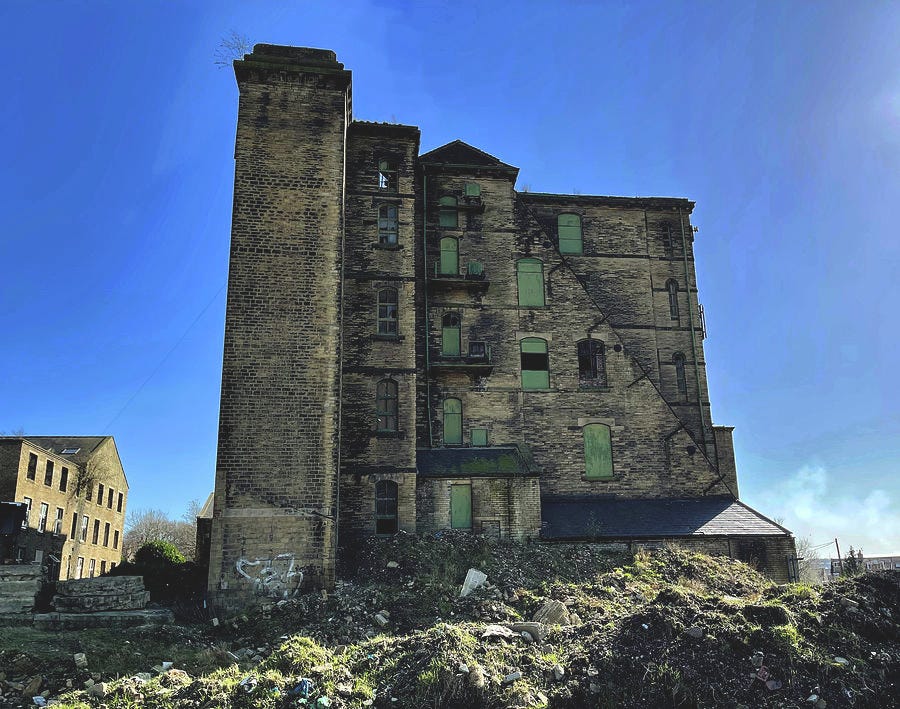
The school, beyond a mossy playground with rusting swings, a seesaw and a collapsing roundabout, was a small one room Victorian building of the sort that hadn’t really existed since the days when rural children lived mainly on farms and all ages were taught together.
High trees loomed above it, the rain, heavier now, pattering gently on the new year green leaves.
Apart from that, it was very still.
They stood before the front door.
With a soft sigh, the trees and other growth shrank back. When Connor turned around the equipment in the playground was brightly painted and for a moment, he heard children laughing.
A handbell rang. The children’s laughter died away. An instant later he felt small, warm bodies brushing past him, and when he turned again, the door of the old school was wide open.
For just an instant he was surprised but then he remembered this was what always happened and that afterwards, he always forgot.
Connor looked around and found that Hassan was not with him anymore.
…
A week later in his office he opened a hand-addressed letter with a faded photo and a note inside.
The photo, aged, dark Bluetack at each corner, the image, stained with spots of turmeric, was of himself and Hassan together outside the old Grimford takeaway in bright sunshine, each other’s skinny arms around each other’s skinny shoulders, both caught laughing, a pale white boy with a dark brown boy in that frozen instant, happy.
Connor couldn’t remember when or why it had been taken, or by who. Probably one of Hassan’s parents.
The note, written on a takeway order chit, in hard unfussy blue biro, was very short.
“My dear Connor, my Brother Stinker,” it said. “I’m glad one of us made it out and I’m glad it was you. I wish there was more, but this is all I have left for you. I hope it is enough.”
Connor turned the envelope over and saw by the postmark it had been sent a year ago.
He thought for a while.
“Thank you, Brother Stinker,” he whispered. “Thank you for coming after me.”
He stuck the photo, above the desk at which he wrote poems.
And then he sat there on his own thinking more, looking back, trying so hard to remember, hard to remember many things for a very long time.
Then Marla called for him, because it was glorious May outside, and it was time for brunch.
It was Saturday morning. They were comfortable, healthy, and their children were old and sensible enough to look after themselves, so why not?
Paratha and eggs with chilli-salt and pepper under their cherry tree.
Marla took a photo and sent it to the group.
…
The end.